
hypnotherapy FAQs

When mind, body and soul work in harmony, we remember our wholeness.

what is it all about
Everything you want to ask about hypnotherapy
You have questions. I love that.
Curiosity is one of my favorite human qualities, and asking good questions is often where healing begins.
So whether you're here because you're excited, skeptical, a little nervous, scientifically minded, spiritually curious, or simply doing your due diligence before booking a session—welcome.
Before we dive into the FAQs, I've included a brief overview of hypnotherapy and the approaches I use. After that, you'll find just about every question I've ever been asked (and quite a few I've imagined people might ask!).
You don't have to read every answer before deciding to work with me.
But if you're the sort of person who likes to know how things work... you're in good company.
If you reach the bottom and you're still wondering about something, drop me a line. If it's a good question—and it probably will be—we'll add it to the collection.
Everything you could want to know about Hypnotherapy
Hypnotherapy FAQs
what is Clinical Hypnotherapy?
Despite what stage shows and Hollywood might have us believe, hypnosis isn't magic, nor is it about losing control or clucking like a chicken - it's about gaining access.
Clinical hypnotherapy is a naturally occurring state of focused awareness that we call the ‘hypnotic trance’ where the conscious, analytical mind becomes a little quieter, allowing us to work more directly with the subconscious. It's a collaborative process where you're awake, lucid, aware, and able to stop at any time. Most people describe it as feeling deeply relaxed, absorbed, or similar to that drifting state just before falling asleep or waking up.
We are constantly visiting that place of trance; when we drive, when we watch TV (bad), when we scroll our phones (worse), when we do that weird zone-out-and-stare-into-space thing when we are tired (totally ok). When we put ourselves intentionally into that place we get to choose what we do with that state. Hypnotherapy is doing therapy while in a state of hypnosis which super amplifies its effects.
I speak about Brainspotting elsewhere. It is also based on the hypnosis trance which is why I love it and find it is sometimes even faster than hypnosis for getting to root cause, but I’m getting ahead of myself.
Conversational Hypnosis also exists, that is hypnosis that happens without a formal induction and with eyes open.
Where does it work?
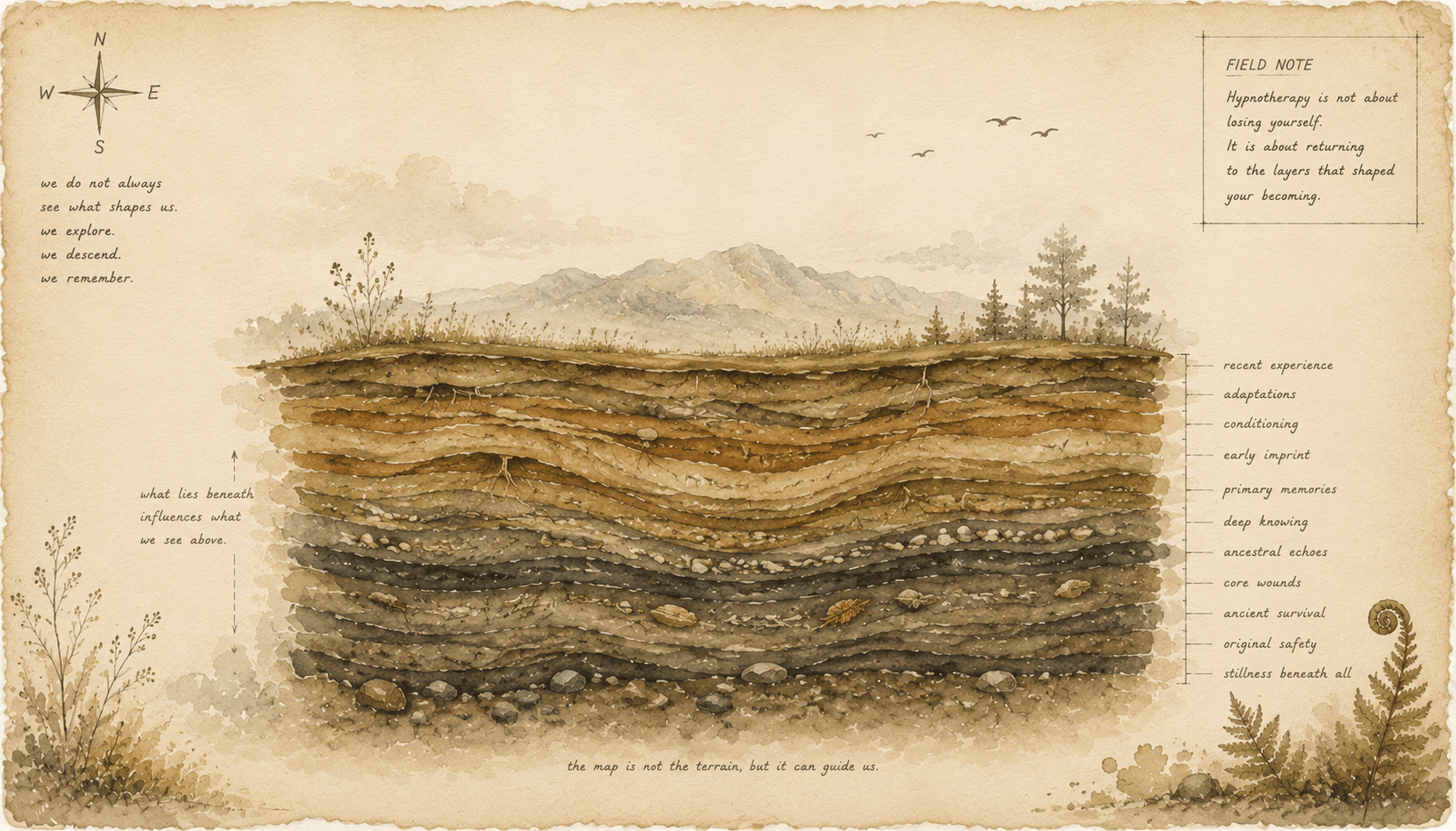
Much of what shapes our lives happens below conscious awareness.
Our habits, emotional responses, protective patterns, beliefs about ourselves, and even the way our nervous system reacts to the world are often rooted in subconscious learning.
Think about the iceberg metaphor, the biggest most influential building blocks of our lives are below the waterline, outside of our awareness.
Hypnotherapy allows us to work with those deeper layers, where lasting change is often easier than trying to think our way into a different life.
Who is it for?
Clinical hypnotherapy is a wonderful fit for people who are curious, open to exploring themselves, and ready to move beyond simply understanding their patterns.
It's particularly helpful if you've ever found yourself saying:
"I know why I do this... I just can't seem to stop."
Insight is valuable. Oftentimes the subconscious needs to experience something different before your life can begin to change.
When do I use it?
Hypnotherapy is one of the core approaches I draw on, but not because I believe it's the answer to everything but because it amplifies everything.
I use hypnotherapy when change needs to happen at a deep level before your cognitive mind will allow you to accept new stories or beliefs more aligned with your life and your goals.
Sometimes we'll spend most of a session in hypnosis.
Sometimes we'll use it briefly alongside conversation, somatic work or breathwork.
Every session is tailored to you.
How does it work?
The subconscious isn't irrational. It's protective. Many of the patterns we struggle with today were once intelligent adaptations that helped us survive but are now redundant.
Hypnotherapy creates an opportunity to revisit those patterns with the resources, safety and awareness you have now, allowing your mind and nervous system to update what no longer serves you.
Rather than fighting against yourself, we work with the part of you that's been trying to help all along.
How does a hypnotherapy session feel?
Most people are surprised by how ordinary it feels.
You won't be unconscious. You won't lose control. You won't reveal secrets you don't want to share. You won’t quack like a duck (I charge extra for that).
Instead, you'll probably feel deeply relaxed, focused, and more connected to yourself than usual.
Many people leave feeling lighter, calmer, and with a sense that something subtle but significant has shifted.
Because often, it has.
Why I Love It
I love hypnotherapy because it works at the location of the problem. We gently quiet the busy, analytical mind and work directly with the deeper patterns that have been shaping your life all along. Instead of forcing change from the outside in with affirmations we don’t yet believe or painful habit change, it creates the conditions for change to arise naturally from the inside out. It’s like it gently radiates from the inside out.
Rapid Transformational Therapy (RTT)
What is it?
Rapid Transformational Therapy (RTT) is the framework I use once we're working in hypnosis. Developed by Marisa Peer, RTT brings together the most effective elements of hypnotherapy, psychotherapy, cognitive behavioural therapy (CBT), solution-focused therapy and neuroscience into one integrative approach. Rather than simply helping you relax, RTT is designed to uncover the root of an issue, help you understand why it developed, and create new, healthier patterns that better serve your life.
What does it work with?
RTT works with the deeper beliefs and emotional patterns that often sit beneath anxiety, low self-worth, people-pleasing, perfectionism, procrastination, fears, habits, relationship struggles and many other recurring challenges.
If you've ever thought,
"I know why I do this... so why do I keep doing it?"
RTT helps bridge the gap between insight and change.
Who is it for?
RTT is ideal for people who want to understand themselves more deeply without spending years circling the same story.
It's particularly powerful if you're naturally curious, open-minded, and ready to look beneath the surface with compassion rather than judgement.
When do I use it?
RTT forms the backbone of many of my hypnosis sessions, but I don't use it as a rigid protocol. Every person is different, so I draw on the parts of RTT that best support your healing, weaving them together with nervous system work, somatic approaches, Brainspotting, breathwork and psychotherapy where appropriate.
Again, my loyalty isn't to a modality. It's to your healing.
Why do I use it?
One of the things I love most about RTT is that it doesn't stop at asking what happened—it asks why your mind responded the way it did.
Your subconscious has always been trying to protect you. Even the patterns that frustrate you today usually began as intelligent adaptations.
When we understand the purpose behind those patterns, something shifts.
We stop fighting ourselves.
And once we stop fighting ourselves, change becomes much easier.
What does it feel like?
People often expect something dramatic.
Most are surprised by how natural it feels.
It's a deeply conversational process where memories, emotions, insights and understanding begin to connect in ways they often haven't before. Clients frequently describe moments of profound clarity—finally understanding not only what happened, but why it shaped them the way it did.
For many people, that understanding becomes the beginning of genuine freedom.
Why I love it?
I love RTT because it takes great therapeutic tools and superchargest them. People stop seeing themselves as "broken” and begin to understand that every behavior had a reason. Watching shame transform into self-compassion is one of my favorite moments in this work.
Soul Journeying
Transpersonal (Spiritual) Hypnotherapy
What are Soul Journeys?
Some questions belong to psychology. Others belong to the soul.
Most of my work focuses on the conscious mind, the subconscious and the nervous system.
Soul Journeys explore another layer of consciousness entirely.
For some people, healing reaches a point where the questions become less about "Why do I feel this way?" and more about "Who am I, really?" They feel a longing to explore something larger than this lifetime—a deeper sense of identity, meaning and connection. All cultures have had their traditions to journey to the soul world whether by plant, chant or drum.
Soul Journeys include Past Life Regression and Life Between Lives Regression, two transpersonal approaches that invite us into that exploration.
You don't need to hold any particular spiritual beliefs to approach this work. Curiosity is enough.
Past Life Regression
What is it?
Past Life Regression is a guided hypnotic experience in which people explore symbolic or remembered experiences that appear to exist beyond their present lifetime.
Some people experience these journeys as literal memories.
Others experience them as profound metaphors created by the unconscious.
From my perspective, what matters most isn't proving whether a past life is objectively real.
It's whether the experience brings healing, insight, compassion or freedom into your life today.
What does it work with?
People often explore Past Life Regression when they experience:
· recurring fears or phobias without an obvious origin
· relationship patterns that feel strangely familiar
· a deep sense of déjà vu or recognition
· recurring dreams
· unexplained emotional themes
· curiosity about the deeper story of their soul
Sometimes the experience offers understanding.
Sometimes closure.
Sometimes simply a different way of seeing yourself.
Who is it for?
This work tends to attract naturally curious people.
People who have always sensed there might be more to life than what can be measured.
People who are interested in consciousness, spirituality and the possibility that healing extends beyond the boundaries of one lifetime.
It isn't something I recommend to everyone.
It isn't necessary for healing.
But for the people who feel genuinely drawn to it, it can become one of the most meaningful experiences of their lives.
Life Between Lives Regression
What is it?
While Past Life Regression explores previous incarnations, Life Between Lives Regression explores the space between them.
This work was pioneered by Dr. Michael Newton, who discovered that some clients naturally accessed experiences of what they described as the soul world—a place of reflection, learning, guidance and preparation between lifetimes.
Whether you understand these experiences spiritually, symbolically or somewhere in between, they often offer a profound sense of perspective.
What does it explore?
People often come with questions like:
Why am I here?
What gifts am I here to share?
Why have certain people appeared in my life?
What is my soul trying to learn?
What happens after we die?
Rather than giving intellectual answers, these journeys invite people into an experience that often feels deeply personal and meaningful.
When do I use it?
This part of my work is very soul-led. I never set out intentional to go to past lives or the soul world. Our intention is always on your healing and growth. If our healing takes us to your childhood we go there, if it takes us to last year we go there. If it takes us to meet your soul family in the place beyond we go there. If it takes us to a crystalline planet of pure love, that’s where we end up.
That said, I have learned to respect that when people come forward with a deep yearning to experience something from beyond this consciousness, from the superconsciousness, that there is often deep wisdom there and we do indeed find something interesting to bring back.
What if I don't want to experience a past life? Can you guarantee that I won't?
Hypnotherapy is a collaborative process, and you remain in control throughout the session. My intention is always to follow your goals, not my own agenda.
That said, I can't honestly guarantee what your unconscious mind may bring forward. In my experience, spontaneously encountering past-life memories during ordinary hypnotherapy is relatively uncommon. Most sessions stay focused on the experiences, emotions and patterns of this lifetime—which, let's be honest, usually gives us plenty to work with.
I never ask clients to adopt my spiritual beliefs. My role is to work respectfully within your worldview, whatever that may be. If exploring past lives or transpersonal experiences doesn't resonate with your beliefs or simply isn't something you're interested in, that's absolutely okay. We can steer the session as it unfolds.
Why I Love It
I absolutely love this part of my work. Soul Journeys invite us into the great mystery of being human. Why are we here? What’s it all about? It is so deeply fascinating to me. Throughout history, people have sought meaning through dreams, myths, meditation, prayer, ceremony and mystical experience that we’ve become estranged from. I see Soul Journeys as part of that long human tradition of exploring consciousness with humility and wonder.
Some clients leave with answers. Others leave with more questions. Some have profound life-changing experiences. Others simply say ‘that was cool… now what.’ Each soul gets what’s meant for them. For me, the greatest gift of this work is that it often leaves people with a renewed sense of meaning, belonging and reverence for life itself.
Frequently Asked Questions about Hypnotherapy
Before Your Session
Can I be hypnotized?
Almost everyone can experience hypnosis.
The real question isn't whether you can be hypnotized—it's whether you're willing to follow the process.
You don't need to try hard, empty your mind or make anything happen.
Curiosity and a willingness to participate are far more important than having the "perfect" trance.
Will I lose control?
No.
This is probably the biggest myth about hypnosis.
You're aware the entire time. You can speak, ask questions, laugh, cry, move, or stop the session whenever you want.
Hypnosis isn't about giving up control.
It's about temporarily quieting the analytical part of your mind so the deeper parts of you have room to speak.
Can I get stuck in hypnosis?
No.
Despite what films and stage hypnotists would have you believe, nobody gets stuck in hypnosis.
If for some reason we were interrupted during an online session, you'd simply open your eyes, stretch, or even drift into a short nap if you were especially relaxed.
Your brain naturally returns to its normal waking state.
Is hypnotherapy scientifically backed?
Yes. Absolutely.
Clinical hypnosis is one of the most researched complementary therapeutic approaches in psychology and medicine. There are thousands of published scientific papers, including randomized controlled trials, systematic reviews and meta-analyses investigating its use across a wide range of conditions. Research has found evidence supporting hypnosis for areas including pain management, anxiety, irritable bowel syndrome, medical procedures, habit change, and as an adjunct to psychotherapy for a variety of mental and physical health concerns.
There's honestly far too much research for me to summarize here.
If you're a science nerd (we’re all nerds here by the time we’ve read this much), try this:
Go to Google or your favorite AI and search:
scholarly articles hypnotherapy for[insert your condition]
For example:
· scholarly articles hypnotherapy for anxiety
· scholarly articles hypnotherapy for depression
· scholarly articles hypnotherapy for sexual health
· scholarly articles hypnotherapy for smoking cessation
· scholarly articles hypnotherapy for trauma
You'll find no shortage of research to explore.
I'm also building a Rabbit Hole section of my website where I'll be collecting some of my favorite papers and resources for those who enjoy diving into the science.
What if I do it wrong?
Good news...
There really isn't a way to do hypnotherapy wrong.
You don't need to relax perfectly.
You don't need to say the right thing.
You don't need to force memories or insights.
Your only job is to show up honestly.
My job is to guide the process.
Why doesn’t hypnotherapy work for everyone?
Unfortunately there isn’t the one champion healing method that works for everyone. Not in the medical system, not in the mental health system. It just isn’t how the world works or our bodies work.
Oh how this fact pains me too.
Hypnotherapy isn't about whether someone is "hypnotizable,” its about the right conditions being in place.
I’ve personally had sessions with the ‘miracle’ healers with no results and profound experiences with people still in training.
More often, the biggest influences are readiness, safety, therapeutic relationship, and whether we're addressing the right issue.
Sometimes another approach—such as Brainspotting or Somatic Experiencing—is simply a better doorway.
My commitment is never to make hypnotherapy fit everyone. It's to find the approach that best supports your healing.
Can I swear?
Please do.
You can shout and scream if you want!
Anger isn't the enemy. Suppressing it often is.
My therapy room is a judgement-free zone. Sometimes healing sounds like quiet tears.
Sometimes it sounds like laughter.
Sometimes it sounds like a very well-earned "F*** you"…
I remember my teacher called that the ‘the fuck you’ therapy… extremely cathartic,
No one gets hurt. No furniture gets thrown.
But your inner child might finally get to say everything they've been swallowing for years.
Everything is welcome.
Do I need to prepare?
Not much.
Come hydrated, wear comfortable clothes, and try not to schedule something stressful immediately afterwards.
More importantly...
Leave perfection at home.
You don't need to have your thoughts organized or know exactly what you want to say.
If you already had all the answers, you wouldn't need me.
What if I'm really analytical?
Excellent.
I love analytical minds.
I'm not trying to get rid of yours—I'm simply inviting it to take a well-earned coffee break while we listen to the parts of you that don't communicate through spreadsheets and logic.
Don't worry.
I'll give your analytical mind back before you leave.
Do I need to believe in hypnosis for it to work?
No. Healthy skepticism is welcome.
You don't have to believe in hypnosis any more than you have to believe in sleep.
You simply have to be willing to participate.
An open mind is essential. A perfect believer is not.
Do you take insurance for hypnotherapy?
Unfortunately, no.
Clinical hypnotherapy is a certified profession rather than a licensed one, so insurance reimbursement has traditionally been very limited. Most insurance companies don't recognize it as a billable medical service in the same way they do licensed mental health professions.
That said, there is some good news.
On a handful of occasions, clients have successfully received reimbursement from their insurance company after paying for their session themselves. Rather than billing it as a coded medical service, the insurer reimbursed it as an out-of-pocket healthcare expense.
I can't promise that your insurance provider will do this, but it's always worth asking.
The landscape is slowly changing. As insurance companies begin recognizing more complementary therapies—including, in some cases, treatments like Reiki—I hope we'll continue to see greater access to approaches like hypnotherapy in the years ahead.
If reimbursement is important to you, I'm happy to provide a receipt for your session that you can submit to your insurance company.
Frequently Asked Questions about Hypnotherapy
During Your Session
What does hypnotherapy feel like?
Everyone experiences hypnosis a little differently.
Some people feel deeply relaxed, as though they're drifting between waking and sleeping. Others feel wide awake the entire time. Some notice a floating sensation, while others simply feel calm and focused.
There isn't one "right" way to experience hypnosis.
The depth of your relaxation isn't what determines whether it works. I've seen people have profound breakthroughs in a light trance and others in a very deep one.
However it feels for you, trust that your mind is doing exactly what it needs to do.
How does hypnotherapy work?
Hypnosis isn't magic.
It's a naturally occurring state of focused attention that we all move through every day—when we're daydreaming, absorbed in a good book, driving on autopilot, or just before we fall asleep.
In this state, the conscious mind becomes quieter, making it easier to access memories, emotions, beliefs and patterns held in the subconscious.
That's where lasting change begins.
Will I remember what happened during the session?
Almost certainly, yes.
The vast majority of people remember their entire hypnotherapy session much like they would remember any meaningful conversation. You may feel deeply relaxed or notice that your sense of time changes, but you're still aware of what's happening and you'll usually remember it afterwards.
A very small percentage of people naturally enter an exceptionally deep hypnotic state called somnambulism, where parts of the experience may not be remembered. This is thought to occur in only a small minority of people and appears to be much less common today than it once was.
Even if someone remembers very little, the therapeutic work can still be effective. Fortunately, most people remember everything, and many are surprised by just how aware they felt throughout the process.
If we're recording your session, you'll also have the opportunity to listen back afterwards if you'd like to revisit any insights or breakthroughs.
What if I already know why I have this problem?
Wonderful. Sometimes you do. Sometimes you don't.
But understanding why something happened and actually changing how it's held in your nervous system are two different things.
Even when clients think they know the root of an issue, they almost always discover new layers, new perspectives or entirely different memories than they expected.
Insight is important.
Transformation happens when insight becomes experience.
What if I don't see anything during hypnosis?
That's completely normal. People experience hypnosis in different ways.
Some people see vivid mental images like watching a movie. Others hear words or conversations.
Some mainly notice emotions or physical sensations. Others simply have a deep knowing without seeing or hearing anything at all.
There isn't a "correct" way to experience hypnosis. We'll work with whatever language your subconscious naturally speaks.
What if I remember something painful?
Then we'll work with it—gently. You're never reliving the past. You're observing it from the safety of the present.
One of the beautiful things about hypnosis is that it allows us to revisit difficult experiences without becoming overwhelmed by them. We'll move at the speed of trust, and your nervous system will guide the pace. Nothing is forced.
In fact, many clients are surprised by how compassionate they feel towards their younger selves. Instead of becoming overwhelmed, they often experience the relief of finally being able to witness what happened with the wisdom, safety and resources they have today.
Will you make me cluck like a chicken?
Only if you've paid for the deluxe chicken package.
I'm kidding.
That's stage hypnosis, not clinical hypnotherapy.
Stage hypnotists carefully select highly responsive volunteers who want to entertain an audience. Clinical hypnotherapy is completely different. It's a collaborative therapeutic process designed to help you access your own subconscious mind for healing and personal growth.
You won't bark, dance, confess your deepest secrets or lose control.
The only person influencing your mind during hypnosis is you.
I'm just asking better questions than your inner critic.
Will you make me do or say something against my will?
No.
You remain aware throughout the session and your values, judgement and common sense stay fully intact.
If I suggested something that didn't feel right to you, you'd simply ignore it or tell me so.
Hypnosis isn't mind control.
It's a conversation with the deeper parts of yourself.
What is actually involved in a session?
An Immersion Session lasts around 3–4 hours, giving us plenty of time to build trust, understand your story, and work deeply without feeling rushed.
We begin with an in-depth conversation about what's bringing you here, your history, your goals, and the patterns you've noticed in your life. Often people tell me that this conversation alone helps them understand themselves in a completely new way.
From there we'll move into hypnosis, where we work with the subconscious mind to uncover and resolve the beliefs, emotions and experiences that have been keeping you stuck.
If appropriate, I'll create a personalized hypnotic recording based on your session for you to listen to afterwards. This helps reinforce the new beliefs and patterns we've uncovered together.
Following your session you'll receive integration support, a follow-up coaching call, and email support while everything settles into place.
The goal isn't simply to have a powerful experience.
It's to create lasting change.
Frequently Asked Questions about Hypnotherapy
After Your Session
When will I start to notice changes?
Everyone's healing unfolds differently.
Most people experience one of three patterns:
Spontaneous – You notice a shift during or immediately after your session. You think differently, feel lighter, or respond to life in a new way.
Cumulative– Small changes begin appearing over the following days and weeks. You notice yourself reacting differently, making healthier choices, or feeling more at ease.
Retrospective – One day you suddenly realize you've been different for a while. You look back and think, "Hang on... I don't do that anymore."
There isn't a right timeline.
Trust your nervous system to change at the pace that's right for you.
What if nothing changes?
Sometimes people expect healing to arrive with fireworks.
Sometimes it does.
More often it quietly changes the way you think, feel and respond to life.
The people around you often notice before you do.
If something still feels stuck afterwards, we'll explore why. Healing isn't a straight line, and it doesn't mean you've failed if another layer wants attention.
Sometimes what feels like "nothing happened" is actually your nervous system integrating a significant shift beneath the surface.
How many sessions will I need?
Many people experience profound change after a single hypnotherapy session.
Others choose to continue because new layers emerge, different life themes arise, or they simply enjoy continuing their growth journey.
Sometimes I'll recommend a series of sessions—for example when working with complex trauma, addiction recovery, significant weight transformation, or long-standing patterns.
We'll decide together what feels appropriate for you.
One session? Really?
I know... It often surprises me too.
The sessions are powerful because we're working with the root of the issue rather than continually talking around it.
Sometimes one conversation with the subconscious accomplishes what years of analyzing couldn't.
Sometimes it is the big up-level you’ve been wanting, but the true work is the integration of those changes in the weeks and months following.
Healing isn't a race, it isn’t a destination, these aren’t stand-alone projects.
It’s all of you coming into alignment - yes we want efficiency but not at the expense of blowing your nervous system to bits.
We go at the speed your nervous system can handle. We go at the speed of trust, trust in each other and you trusting in yourself.
Sometimes the work is more gradual and we'll honor that. There is no prize for doing healing quickly.
Do hypnotic recordings actually work? Will you make me one?
Yes they work—but they're not magic.
Hypnotic recordings work best when there's fertile ground for the suggestions to take root.
Think of it like gardening. If the soil is healthy, planting new seeds is easy. If the ground is full of rocks, weeds and compacted earth, the seeds may struggle—not because there's anything wrong with the seeds, but because the ground needs tending first. That's the role of our work together.
During your session, we identify and clear the limiting beliefs, emotional blocks and subconscious patterns that have been keeping you stuck. Once those obstacles begin to soften, your personalized hypnotic recording has somewhere to land.
That's why I sometimes create a custom recording for some clients where I believe there will be a strong benefit. It's designed specifically for your mind, using the insights and breakthroughs from your session, helping your nervous system continue reinforcing those new patterns long after we've finished working together.
If you're using generic recordings on YouTube or elsewhere, my advice is this: Use them to strengthen qualities you already want to grow—like confidence, relaxation, creativity or focus—rather than expecting them to "fix" something that has deeper roots. When the foundation is solid, suggestions become remarkably powerful. When something is still blocking the foundation, it's often kinder to begin there first.
Can I do hypnotherapy in a 75-minute session?
Absolutely—but it depends on what we're working with.
If it's your very first session and you're hoping to resolve a significant, long-standing issue, I usually recommend starting with an Immersion Session. The extra time allows us to build trust, thoroughly understand your story, and work deeply without feeling rushed.
However, if you're coming with a more focused issue—or you're returning for follow-up work—75 minutes is often plenty of time. Many clients use individual sessions for Brainspotting, focused hypnotherapy, integration work, coaching, or working through a specific challenge that doesn't require a full immersion.
If you're unsure which option is right for you, don't worry.
That's exactly what our consultation is for.
Can you guarantee results?
No. And any therapist who guarantees a particular outcome is being unethical.
Every person arrives with a different history, nervous system, life experience and readiness for change. No ethical therapist can promise exactly what your healing journey will look like.
What I can promise is that I'll bring every bit of my skill, experience and presence to our work together.
I'll meet you exactly where you are, move at the speed of trust, and create the best possible conditions for meaningful and lasting change.
The rest is a partnership between you, me, and your remarkable capacity to heal.
Is hypnotherapy done in person or online?
Both. I work with clients in person from my office in Lakewood, Ohio, and online with clients around the world via Zoom.
Online hypnotherapy is every bit as effective as in-person work. As long as you have a quiet, private space where you won't be interrupted, the experience is remarkably similar.
Many people actually prefer being in the comfort of their own home.
What is your cancellation and refund policy?
Life happens.
You're welcome to reschedule your session with at least 48 hours' notice.
Because your session is a significant block of reserved time and involves preparation beforehand, refunds are generally not offered except in exceptional circumstances.
If something unexpected arises, please reach out.
We'll figure it out together.
Frequently Asked Questions about Hypnotherapy
Still Curious?
What's the difference between group and individual hypnotherapy?
Both have their place—they simply do different jobs.
Group hypnosis is generally a guided hypnosis experience and works beautifully for general goals such as relaxation, confidence, stress reduction, sleep, motivation, self-worth or developing healthier habits. There's something surprisingly powerful about sharing an experience with others, even when everyone is working quietly on their own inner world.
Individual hypnotherapy is where we do the deep work.
Trauma, childhood experiences, relationship patterns, grief, addiction, complex emotions and long-standing subconscious beliefs all require a highly personalized approach. Every person's story is unique, so the questions I ask, the memories we explore and the way we work are unique too.
One of the things that makes my work effective is the dialogue we create together. I ask very specific questions to help uncover the root of what's happening beneath the surface. That simply isn't possible in a group setting.
So, if you're looking for a powerful general experience, group hypnosis can be wonderful.
If you're ready to understand and heal your story, that's work best done one-to-one.
What if I don't believe in past lives?
That's absolutely fine.
Past Life Regression is a very small part of my practice, and many of my clients never choose to explore it.
You don't need to share my spiritual curiosity for hypnotherapy to be profoundly effective.
We can do years of beautiful work together without ever mentioning past lives.
If that curiosity is there, wonderful.
If it isn't, that's wonderful too.
Why don't all therapists use hypnotherapy?
Great question.
Every therapist develops the tools that best fit their philosophy, personality and training. Some simply prefer different therapeutic approaches, and that's one of the strengths of our profession.
There's also a practical reality: hypnotherapy is often not reimbursed by insurance companies. For therapists who work within insurance-based systems, that means they simply won't get paid for using it—even if they believe it could benefit their clients.
Hypnotherapy happens to be one of mine because, time and again, I've seen what becomes possible when we work directly with the subconscious mind.
As the research continues to grow, more therapists are becoming interested in integrating hypnosis into their work. I think that's exciting—not because every therapist should practice hypnotherapy, but because clients deserve access to a wide range of evidence-informed approaches to healing.
At the end of the day, I don't really care which modality helps someone heal.
I just care that they heal.
Do you use Internal Family Systems (IFS)?
Internal Family Systems (IFS), developed by Dr. Richard Schwartz, is one of the most well-known approaches to parts work—the understanding that we all have different parts of ourselves that have developed to help us navigate life.
While I haven't formally trained in IFS, I have extensive experience working with parts therapy, particularly Ego States Therapy, which has its own long history and shares many similarities with IFS. Both approaches help us understand and work compassionately with the different protective, wounded and resourceful parts of ourselves. Ego States Therapy tends to be a little less structured, allowing the work to unfold in a way that is unique to each person.
Ultimately, the model is less important than the outcome. My focus is on helping you build a trusting relationship with all parts of yourself so that healing and integration can naturally occur.
Will you judge me?
No, not a chance. In fact, one of the biggest surprises of my career has been discovering just how much we all carry.
When I first started this work, I thought I was the only person who thought certain thoughts, felt certain feelings or carried certain shame.
Then I became a therapist.
It turns out we're all wonderfully, heartbreakingly human.
Whatever happened to you was real.
Whatever you're carrying deserves compassion, not comparison.
There is very little you could tell me that would shock me.
There is absolutely nothing you could tell me that would make me stop seeing your humanity.
I've read all your gazillion questions... and I still have another one.
Touché, my friend.
You win this one.
If your question isn't here, send me an email or book a consultation.
I genuinely love curious people, and if you're wondering it, there's a good chance someone else is too.
I'd much rather you ask than spend hours trying to figure it out on your own.
Besides...
Questions are usually where healing begins.
“I was fighting addiction following childhood abuse, I was uncertain that hypnotherapy would be an effective treatment for me and brought in a healthy amount of skepticism. It was a great exercise in trust.
Moyra is very thorough in her process, really taking the time to get to know you. She is fully committed to speaking positive energy into your life and helping you let go of the bad. I would recommend the service to anyone who is fighting a barrier in their life and anyone who feels stuck and needs to move into a positive mindset.”
— John B
so… are we doing this?
Book a Free Consultation.
If you've made it this far, you might be wondering which of these approaches is right for you.
You know my answer, you don't need to know. (While also if you’re like ‘that sounds cool’ then we absolutely should go there!)
Most people don't arrive saying, "I need Brainspotting," or, "Today's the day for hypnotherapy." They come because they're anxious, grieving, burnt out, stuck, or simply know that life could feel different.
My job is to understand your story, listen to your nervous system, and weave the best approaches that support your healing.
The modality is never the healing. You are.
These are simply the tools we use to help you remember what has always been there beneath the survival, the stress and the stories you've had to carry.
If you're still curious about working together, the best place to begin is a consultation. We'll talk about what's bringing you here, answer your questions, and together decide what feels like the right next step.
You don't need to have it all figured out.
That's what I'm here for.
“Before my session I was unable to experience sex with my loving partner without feeling shame.
In my session I uncovered a childhood memory of getting in trouble and feeling shame around my body. After healing this through the session, I was able to enjoy sex without the need to be shamed or talked down to for the first time in my life.
I finally experience sex simply for the pleasure of it - with no shame attached! It’s totally different and life changing and I didn’t even go into the session expecting that to happen!
I feel so much more secure, less needy and confident. Every single person on earth would 100% benefit from this therapy!”
— Name WithheldI love sharing my experience with Moyra because it was so completely unexpected. I had been experience some really overwhelming emotional baggage so to speak. I felt so weighed down. I felt like there was some hurt that I couldn't heal from because I couldn't identify it, so I thought I would give hypnotherapy a try.
My first surprise was how completely 100% aware I was during the entire session, yet I still felt this sort of detachment from myself. I was able to recall events from my life, events that I had certainly recalled many times before in other therapeutic sessions, but was able to do so without the emotional attachment. In doing so, I was able to discover how those events connected to the emotions and feelings I was dealing with in my present life.
For probably 5 years prior, I had not had a solid good night's sleep because of the pain in my hips and shoulders. I tossed and turned all night because I had to turn to relieve the pain. That night, I had the best night's sleep ever. And the next and the next and the next. I kept waiting for the pain to return. A week. Two. A month. Three. Nearly 6 months now and I still am sleeping so well! Virtually pain free.
This hypnotherapy session was one of the best things I have ever done. And I have plans to have another session next year to address another issue ;) Thank you Moyra Michelle!
— Devaney CA quick (but important) note: I'm a certified clinical hypnotherapist and healing practitioner, not a medical doctor. Everything shared on this website is for educational purposes and shouldn't be taken as medical advice or a substitute for appropriate healthcare. If you're experiencing a medical or mental health emergency, please contact your healthcare provider or local emergency services.